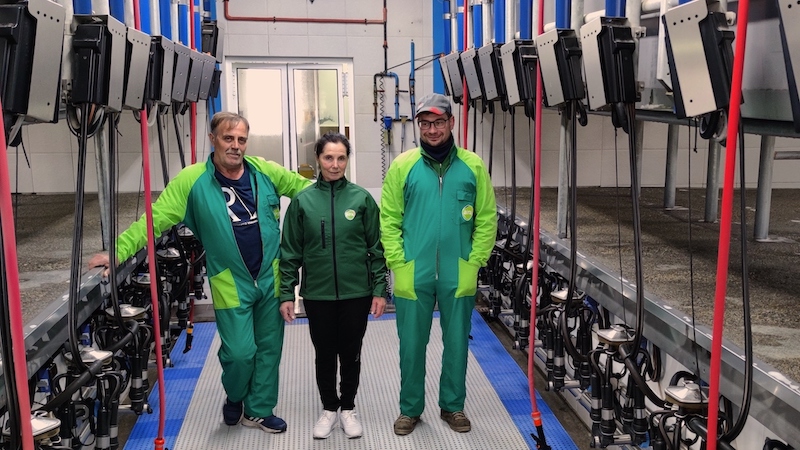
In the parish of Augas Santas, in the place of Bouzachás, in Palas de Rei, is located the San Xorxe Livestock Farm, one of the partner farms of the AIRA Cooperative in this area. It is run by three partners: the couple Victoriano Blanco and Chelo Viña, together with Carlos Pérez. It has been 16 years since they began to operate as SAT, although in those early years they had another partner, who four years ago decided to leave the company. “In the Cooperative, which at that time was Agris, they knew of the need we had to expand and they put us in contact. That is how we started SAT”, they explain.
The cordiality and understanding between them allowed them to grow and consolidate. Today it has about 190 head of cattle, about 95 in milking and about 90 animals for rebreeding. All of them are Friesian breed animals. “We have been betting on genetic improvement and on animals with proven aptitudes for more than 25 years, hand in hand with Semex”, they admit. Bulls such as Unix, Eugenio, Pegasus or Sidekick are some of the sires they have been opting for in recent years, although many of the cows are also daughters of historical sires such as Rudolph or Dolman. Thus, they never opt for crossbreeding.
“We have tried genomic bulls, but we are going to continue with proven bulls, because of the good results they achieve, even if they are more expensive
”
“We have always invested a lot in genetics. There were times when we inseminated with doses of 60 euros because they were very well endorsed sires in the market”, they remember. They seek to improve udders, legs and the animal’s body condition. “We are for having big animals, because of the good results they give us. We have also worked a little with genomic bulls, but they did not convince us and we will continue to bet on proven bulls, even though they may be more expensive,” they say. The heifers start with a production of 40 liters and in the second calving they are already at 56 liters and reach 60 liters in the third lactation. “We already have animals with a good milking speed and good milk quality, but we are still betting on that,” they explain.
The milk is also marketed through the Cooperative and has an average production of about 37 liters per cow, with an average quality of 4.10 fat and over 3.40 protein. The somatic cell count is below 117,000 and bacteriology is always below 10,000 units. Three years ago they also faced the enlargement of the milking parlor, adding 8 milking points and to have 20 points with which to better face the daily milking, a task for which Chelo is responsible, together with the cleaning. They are among the AIRA herds that are certified and have the Animal Welfare seal. “It is a way to pay better for the milk and they are seals that are increasingly in demand,” they point out.
Territorial basis of livestock farming
Carlos is responsible for forage and land management. San Xorxe Livestock manages a land base of 85 hectares, of which about 35 hectares are dedicated to corn cultivation, while the rest is under permanent pasture. Except for the silage, Carlos is in charge of all the other work on the land, from fertilizing to sowing the corn or mowing the grass.
“We plant corn very early. We’ve been planting more than half of it by March 30 for years
.”
One of the priority forage crops for livestock is corn, which is usually planted in early spring. “We plant corn very early. In recent years, we have sown more than half of it by March 30,” they admit. This allows them, among other advantages, greater availability of machinery to make silage. “We silage at the beginning of September, when there is still not much corn to harvest, and that allows us to do it when it is best for us,” they explain.
In the first sowings they opt for cycles of 300 and reduce if the last sowings are delayed due to the weather. This year, with the very sunny days that came, at the beginning of February they already had a good part of the corn land prepared for planting. Wanting to plant corn so early forces them to harvest only a short cutting of grass in those meadows that alternate with corn.
Cattle feeding
Victoriano supervises the daily feeding of the cattle. For the cows in production they have a ration based on 14 kilos of grass silage, 34 kilos of corn silage, half a kilo of straw and 13 kilos of feed. In the feeding they count on the advice of specialized AIRA technicians such as Aurora Vila and José Luis López. “We have been buying feed from AIRA almost since the Taboada factory started operating,” they recall.
Victoriano is also in charge of the cattle registration and deregistration, and he is also in charge of the cattle invoicing. The rebreeding cows are kept on warm bedding, while the rest are on wood sawdust bedding with 70% calcium carbonate. “By stirring it every day, you get good bedding and reduce the risk of infection with mastitis. It is also an important contribution to the soil, which we already provide mixed with the slurry,” they explain.
At the San Xorxe livestock farm, they also take advantage of the Cooperative’s substitution program, which allows them to better reconcile work and family life.
Published in the February 2022 AIRA newsletter.