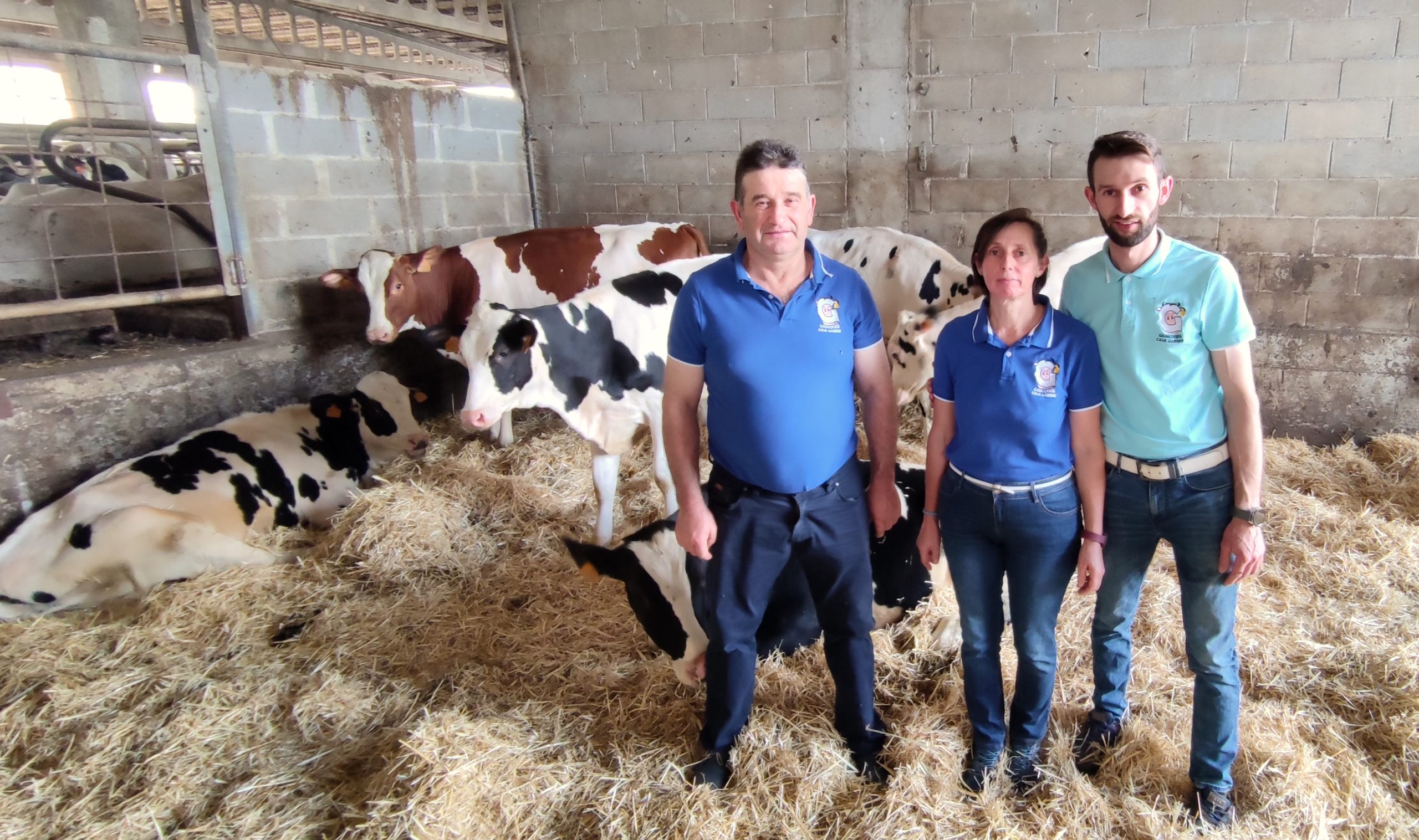
The family livestock farm Casa Gabino SC of Friol (Lugo) is one of AIRA’s partner dairy farms. María José Lorenzo and José Higinio Río, together with their son Iván are at the head of the herd, which has a herd of about 170 head, of which they have about 80 in milking.
Casa Gabino is one of the Galician cattle ranches that is firmly committed to genetic improvement as a fundamental tool to achieve a profitable farm. For the last 10 years they have been dedicating important resources and efforts to achieve a herd of animals not only with a good production but also with high genetic value.
“The first steps were taken with the purchase of four animals at the last auction of the Bos Embryo Transfer Center, with two animals of good genetics that we had on the farm and using selected embryos,” recalls Iván. It was precisely him who was the main driving force behind this bet on the farm.
Along with genetic improvement, Casa Gabino was one of the first farms that wanted to genotype their animals. Today, the entire herd is genotyped, which allows them to have more information when making decisions to obtain the animals they are looking for. “Many farms only have the heifers genotyped, but it is important to have them all because it allows you to choose the animals being aware of the possibilities you have of getting what you are looking for.
Many times a cow with a good milk production will not transmit those values to her offspring and you know that with genotyping,” the farmer points out.
They have animals of high genetic value and the entire herd genotyped to continue betting on achieving the animals they want
Iván recognizes that he has a differentiated way of approaching genetic improvement on the farm, betting on making the couplings for each animal in particular, while many cattle ranches opt to work with 3 or 4 sires that provide them with the results they are looking for.
“It is a methodology that would be unfeasible for larger herds, but in my case, although it involves a lot of work, it is feasible and we get the animals we are looking for,” he explains.
Most of his herd is of the Friesian breed, although recently he has also incorporated two Fleckvieh cattle, because he knows for himself the potential of this breed of Austrian origin, which has a double aptitude, both for meat and milk. “We are committed to the Friesian breed and we are not going to change the herd, nor make crosses, but it is another line that we want to study and see if it can be profitable on the farm”, he points out.
Not only milk brings value to the farm
The bet on genetics became another source of income for the cattle ranch apart from milk. “We live off milk production, but this is a way to improve profitability, although initially it involves a significant investment,” he acknowledges.
The average production per cow is about 35 liters, with an average milk quality of 4.20% fat and 3.45% protein. The milk is marketed through the Cooperative and they have the advice of AIRA’s milk quality control.
They have the herd in stalls and milk in a 10-point parlor. They are about to start work to install a milking robot. “Once we are working with it we will evaluate if we continue with the two systems or if we install a second robot,” he specifies.
The sale of animals of high genetic value is another way to increase profitability for the farm. Thus, in these years they have already sold more than 60 males as stallions for other farms and 9 of them for the Fontao Genetics Center, as well as embryos. At the moment, the females are used for their own rebreeding, but they also plan to sell calving heifers.
In their day-to-day work on the farm and with a firm commitment to animals of high genetic value, they make use of the Cooperative’s advisory services in areas such as livestock nutrition, reproduction and clinical veterinary care. “They always try to find solutions in the shortest possible time and help you to manage the farm well”, says the farmer.
Today this cattle ranch is among the 25 best in Spain by ICO and among the 10 best in Galicia.
Published in the September 2022 AIRA newsletter.