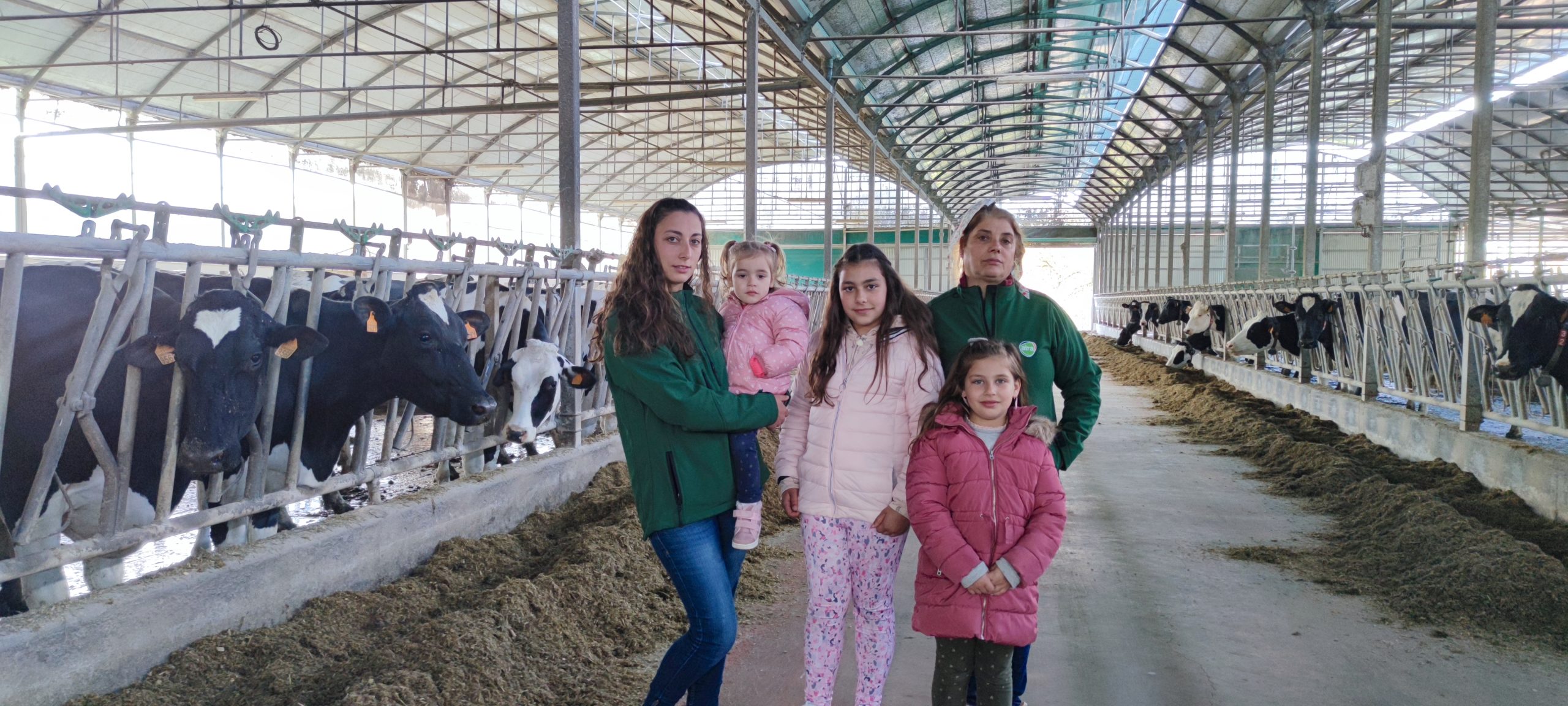
The Currás Xiá cattle farm in Friol (Lugo), one of AIRA’s partner farms focused on milk production, is one of the family farms where the renewal has come from the daughter, Inés Jul López, who is now in charge of the daily management of the animals together with her mother, Monserrat. Meanwhile, Plácido, father, husband and founding partner of the cattle ranch, is more focused on land management.
“We split the work, but usually the two of us take care of the animals and the daily farm routines like milking and my father does the outside. We are all very aware of the importance of both the work on the farm and the work on the land. Without one it would not make sense nor would the other be viable,” Inés points out. For the last few months they have also had an employee to help with tasks such as cleaning the animals.
Although Inés worked for some years in another sector, she decided to return to Friol 12 years ago and join the livestock farm, in which she is fully involved. The change, in addition to other advantages, allows her three young daughters, Uxía, Erea and Iria, to enjoy livestock farming. “I like that the girls are on the farm with my mother and me and they have a good time here,” says the farmer.
Currás Xiá is today one of the leading dairy cattle farms in the municipality of Friol. With more than 300 head, it has about 140 milking cows and a production of about 145,000 liters of milk per month, which it sells to the Cooperative. Its average production is 37 liters per animal. It is one of the farms that are certified in milk production in AIRA.
They have about 140 Friesian cows in milking and a production of about 145,000 liters of milk that they sell to the Cooperative. They are from certified farms
. In the Currás Xiá farm, the entire herd is of the Friesian breed. In the newest facilities, which they built 9 years ago, they have the animals in production. They have just installed a milking robot to alleviate the workload, but they also keep milking in the milking parlor due to the number of cows they milk. Thus, the cows in production are divided into two lots, depending on whether they are milked in the robot or in the parlor.
The rations are adapted to each of these two milking systems. The ration of the cows milked in the parlor has 23 kilos of corn silage, about 20 kilos of grass silage and 10 kilos of concentrate. Meanwhile, the cows that are milked in the robot have a ration of 23 kilos of corn silage, another 23 kilos of grass silage and 5 kilos of concentrate “since the rest of the feed is given in the robot,” explains Aurora Vila, an Aira technician who is in charge of advising on feeding in the herd.
“
Once pregnant, the cows are in the pasture until almost a month before calving, when they return to the farm
”
In the old facilities of the farm, located next to the family house, they have the rebreeding divided by lots according to the age of the animals. Although it is an intensive farm, once the cows are pregnant they are in the pasture until almost a month before calving, when they return to the farm.
The livestock farm manages about 45 hectares of corn, which they have had on two rented plots for years. “The biggest problem is that one of the 20-hectare farms is 10 kilometers from the farm,” Montserrat explains. They also silage about 100 hectares of grass. Although they are largely in charge of fodder production, they count on the services of AIRA machinery for the silage campaign for both grass and corn.
Published in the AIRA Newsletter April 2022